Archive for October, 2009

China

Posted in Uncategorized on October 28, 2009 by dhenisee

China – the world’s oldest living civilisation, with a written history dating back to more than 3,500 years. Its Chinese name zhong guo means ‘middle country’ or ‘the central kingdom’; the ancient Chinese had believed that their country was the geographical centre of the world and its only civilised culture.

For most of its ancient history, China was ruled by a succession of dynasties. Most of these were Han Chinese, except for the foreign Yuan and Qing dynasties. Major dynasties that ruled ancient China are;

  • Shang Dynasty 1766-1045BC
  • Zhou Dynasty 1045-256BC
  • Qin Dynasty 221-206BC
  • Han Dynasty 206BC-AD220

The ancient Chinese were one of the most scientifically advanced civilisations. Their accomplishments include the compass, gunpowder, paper and printing, celebrated by the Chinese as the ‘four great inventions of ancient China’.

Pottery & Porcelain: Chinese potters began making porcelain, a highly-refined form of pottery making, during the Yin and Shang dynasties. While early methods were primitive, advanced porcelain making was made possible by the development of specialised kilns which could fire kaolin, a form of white clay, at very high temperatures of around 1,200°C to obtain a hard, non-porous material.

The first true porcelain, however, was produced during the Tang Dynasty when Chinese potters learnt to control the iron content, which reduced colour interference so the porcelain could be white. Porcelain making was finally mastered during the Ming Dynasty, and high quality porcelain, or ‘china’, was exported to Japan and Europe. By this time, Chinese potters produced porcelain from kaolin, and used a feldspathic stone called petuntse in the process which gave it a translucent, glasslike appearance.

Silk: Ever wondered why silk has a shimmering appearance? It comes from the triangular prism-like structure of the silk fibre, which allows it to refract light.

It is believed that the Chinese first started making silk around 2,700BC. Legend has it that Empress Si Ling Chi discovered silk when a silkworm moth cocoon fell from a mulberry tree into her tea. After some experiment, she finally managed to weave the silk filament into a piece of fabric.

The process of making silk weaving is still the same today. Known as sericulture, the cocoons are placed in hot water to release the silk filaments and kill the silkworm larvae. The filaments are combined to form yarn, wound and finally dried. Each cocoon can yield around 500 to 1,200 yards of silk.

Silk was considered China’s most valuable trade commodity, resulting in the famous Silk Road trading route. Silk making was a closely-guarded government secret until AD300 when it was leaked out to India.

Compass: The world’s first compass was made in China during the Qin Dynasty. It was made with lodestone – an iron oxide-based mineral that aligns itself in a north-south direction due to the Earth’s magnetic field – which was commonly used in Chinese geomancy and fortune-telling.

The use of a compass was recorded in several Chinese texts including a 4th century book entitled the Book of the Devil Valley Master, which describes its use in pathfinding. The first person officially recorded to have used the compass as a navigational aid was Chinese admiral Zheng He, who made eight sea voyages between 1405 and 1433.

Paper & Printing: Paper was invented in China some 3,000 years after the ancient Egyptians used papyrus for writing. Cai Lun, a government official from the eastern Han dynasty, made paper by mixing the bark of a mulberry tree and bamboo fibres with water, draining and drying the mixture on a flat bamboo frame. Other materials used in papermaking included tree bark, hemp, linen and even fishing nets.

During the Tang and Song dynasties, papers were developed for different purposes, including hemp paper, hide paper, bamboo paper, and xuan paper – made from a kind of pine tree – used particularly for calligraphy.

Advances in papermaking were complemented by the development of printing. Block printing, or xylography, was used in China by the 7th century and the earliest known printed text, a Buddhist scripture, was printed in AD868. Printing books was time-consuming, as the blackline method used required a new block to be carved for each page.

Movable type in printing was invented during the Song Dynasty. Movable Chinese characters were carved from wood, which could be arranged as needed and even reused. Later versions used clay, but these broke easily. During the Ming Dynasty, the wooden movable type was refined and books were printed using the two-colour printing process.

The rapid adoption of paper and printing technology in China precipitated the spread of knowledge among the Chinese literary elite and aristocracy.

Gunpowder: During the Han Dynasty, Taoist alchemists researching on an elixir for immortality caused many fires when they experimented with the ingredients sulphur and saltpetre (potassium nitrate). One of these alchemists later wrote an alchemy text, called Book of the Kinship of the Three, that warned against the mixing of certain materials.

By the 8th century during the late Tang dynasty, a formula for gunpowder was established. Made by combining saltpetre and sulphur with charcoal, gunpowder or ‘huo yao’ was first used to make fireworks and signal flares. Later simple hand-grenades were invented, which were thrown at the enemy using a catapult.

During the Song dynasty, gunpowder was used in rifles and rockets. The Song army also packed gunpowder into bamboo tubes and used it as a primitive form of flame-thrower.

In AD1126 a local official called Li Gang recorded the defence of the city of Kaifeng using cannons, inflicting heavy casualties on a marauding nomadic tribe.

Many early mixtures of Chinese gunpowder contained toxic substances such as mercury and arsenic compounds, and could be considered an early form of chemical warfare.

China is filled with awe-inspiring natural sights.  However, it is also home to many man-made wonders.  Some of these, like the legendary Great Wall of China, are ancient edifices; others are more recent engineering feats that are similarly mind-boggling.

The Great Wall of China: The Great Wall of China was first ordered constructed by Emperor Qin during the Qin Dynasty to defend his realm against marauding nomadic tribes, and its construction continued throughout successive Chinese dynasties.

The part of the wall that still remains today formed part of the Silk Road route and was built during the Ming Dynasty. It stretches some 6,350km. Over the centuries, armies were garrisoned along the wall to provide early warning of invasion and a first line of defence. Contrary to belief, its purpose was not so much to deter the northern nomadic tribes and Manchus from entering China, but to prevent them from stealing property and escaping from China.

After the formation of the Qing Dynasty, the wall no longer had any functional use as the country was then ruled by the very people the wall was built to keep out. It then became a source of construction materials for nearby villages and towns, contributing to its deterioration and destruction.

The Terracotta Army: The Terracotta Army was discovered in 1974 near Xi’an during irrigation works. It formed part of Emperor Qin Shi Huang’s mausoleum and consisted of more than 7,000 life-size terracotta figures of warriors, horses and chariots made from a mixture of clay and earth. The Chinese believe in the afterlife and the army was created for Emperor Qin after his death.

When discovered, the army was laid out in full battle formation, and included standing infantry, kneeling archers and charioteers with horses. Meticulously made, the figures had different features, facial expressions and hairstyles. Officers were distinguishable by their uniforms. The restored terracotta army is open for display in the Xi’an First Qin Emperor’s Terracotta Army Museum.

The Forbidden City: The Forbidden City began construction in 1406 during the Ming Dynasty and took 14 years to complete. It stands exactly in the centre of ancient Beijing, and was the political nerve centre of China until the end of the Chinese dynastic era. It was home to 24 Ming and Qing emperors in all.

Rectangular in shape, the Forbidden City is the world’s largest palace complex and covers 720,000 sq m. It is surrounded by a 6m deep moat and 10m high walls thick enough to withstand cannon attacks.

The southern section of the city, or the Outer Court, consists of five halls used for ceremonial purposes. The northern section, or the Inner Court, was the residence of the Emperor and his family, eunuchs and maid-servants.

The buildings within housed the Chinese aristocracy. Yellow – the royal colour – dominated the rooftops. On each corner of the roof are small statuettes, and the number depicted the owner’s social status. The residence of the Emperor had nine statuettes, while ten symbolises heaven and is used only on the most holy building in the entire city.

The Three Gorges Dam: The Yangtze River is China’s longest river, and the third largest in the world. More commonly known among the Chinese as the Chang Jiang, or the ‘long river’, the Yangtze is the lifeblood of northern China but also its greatest source of grief.

Since time immemorial, floods along the Yangtze have flattened towns and killed millions along its banks. To control the Yangtze’s seasonal floods China began constructing the Three Gorges Dam in 1994, a project of monumental proportions.

Built just west of Yichang in the province of Hubei, the Three Gorges Dam will be the largest dam in the world when it is due to be completed in 2009. The dam will be more than 2km long and almost 200m high, and will feature a reservoir with a capacity of more than 31 billion cubic metres.

Not only will the dam control flooding, it will help to improve navigation along the Yangtze and provide immense hydroelectric power to the surrounding regions – experts expect it to create as much power as 18 nuclear power plants.

However, the huge construction project is not without its critics. Some 60,000 hectares of land will be fully submerged by the project, including 160 towns and 16 archaeological sites. Along with the potential destruction of important sites of historical and cultural value, more than 1m Chinese will have been displaced and have to be resettled by the end of the project.

Beijing’s Olympic Marvels: 

The Olympic Stadium – The 80,000-seat Olympic Stadium in Beijing built for the 2008 Olympics cost 3.5bn yuan (£254m). Nicknamed the ‘bird’s nest’ due to the immense latticework of irregularly angled metal girders, the Olympic Stadium will be the centrepiece of the 2008 Olympic Games and will host the opening and closing ceremonies as well as track-and-field competitions.

The stadium is a monumental edifice, it is 330m long, 220m wide, 69m tall and covers an area of some 250,000 sq m. Building the metal lattice-like structure that encircles the stadium consumes almost 50,000 tonnes of steel! Originally planned with a retractable roof, budget constraints led the builders to scrap the idea.

The Beijing National Swimming Centre – Known as the ‘Water Cube’, it was inspired by soap bubbles, and its shape is based on the fundamental arrangement of organic cells in nature. Costing some £72m, the Beijing National Swimming Centre covers around 70,000 sq m and consists of five pools – one of which has a wave machine – as well as water rides. It boasts some 17,000 seats and will host swimming, diving, water polo and synchronised swimming events during the 2008 Olympic Games. It won an award in the 9th International Architecture Exhibition during La Biennale di Venezia in 2004 for its stunning design.
Vilcabamba/ Peru – The Last Capital of the Incas

Posted in Uncategorized on October 18, 2009 by dhenisee

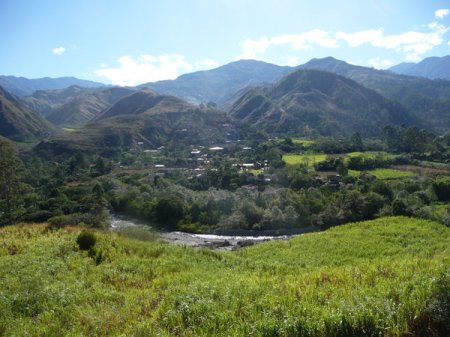
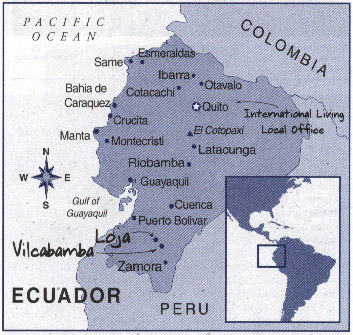
Tucked away deep in southern Ecuador is Vilcabamba, in the heart of the country’s southern province of Loja, bordering Peru. In Quechua, ancient language of the Incas is still spoken today by the Quechua Indians throughout the Andes, “vilca” translates as “sacred” and “bamba” means “valley.” This site was reserved by the Incas for the main noble authorities, as it is a peaceful and quiet place.

From the time of the conquest until 1572, the remnant of the Inca civilization inhabited the area now known as Vilcabamba, an inhospitable region of mountains and jungle between the Urubamba and Apurimac rivers. In 1539, the first capital of this region, Vitcos, was abandoned by Tito Cusi Yupanqui after the death of his father Manco Inca. He moved his people deeper into the forest where he founded a new capital which came to be known as Vilcabamba la Vieja. This last refuge was finally captured by the Spanish in 1572, when it was depopulated and abandoned. By the beginning of the 20th century, Vilcabamba’s original location had been forgotten and its existence was doubted. Hiram Bingham, the discoverer of Machu Picchu and Vitcos, made a brief visit to the site in 1911, found a few ruins among the dense vegetation and declared the site of little importance. He believed that he had already discovered the site of Vilcabamba la Vieja at Machu Picchu.

In 1994 another American, Gene Savoy, retraced the route taken by Bingham to Espiritu Pampa. After a detailed study of the Spanish chronicles, Savoy concleded that Machu Picchu did not match their descriptions of Vilcabamba and that Espiritu Pampa fitted them perfectly.

Today Vilcabamba remains covered by forest and shrouded in mystery. Evidence of its great Inca past is present everywhere and adventurers are drawn irresistably to the site.

article11southamerica07_1180141080_vilcabamba-perx_139

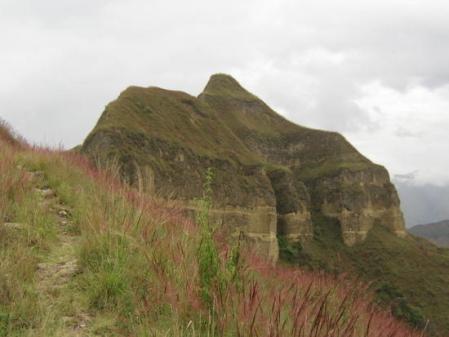
Mandango: “Mandango”, “the sleeping Inca” whose presence is said to protect the area from earthquakes and other natural disasters.

4175214-View-of-Vilcabamba-0inca_art09moche_culture01

Geoglyphs

Posted in Uncategorized on October 13, 2009 by dhenisee

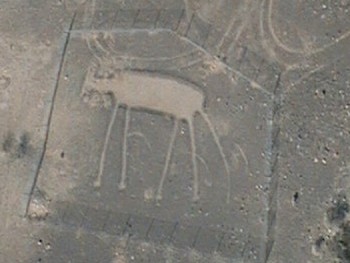
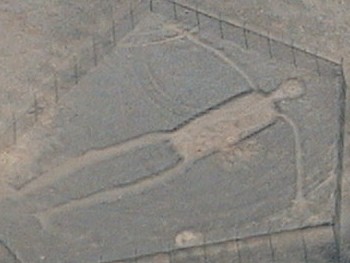
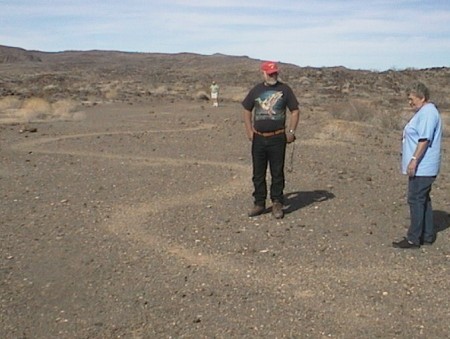
A few years after Charles Lindbergh flew his Spirit of St. Louis from New York to France, another pilot flying along the Colorado River first noticed giant drawings on the desert floor north of Blythe, California. One of the earth figures measured 176 feet in length. Since then, more than two-hundred images have been discovered along the river from Nevada to the Gulf of California. All told, six-hundred-plus geoglyphs have been recorded in the Southwest and nearby areas of Mexico.

Known also as intaglio (in tar yoe), it’s not known if geoglyphs are two-hundred years old or ten thousand. These giant ground paintings depict geometric designs, human form and animal figures. Many have withstood the test of wind, rain and time, others having fallen recent victim to motorcycles, SUV’s, quads and General George S. Patton’s tank-training exercises during WWII.

Geoglyphs were made by carving away the darker top layer of rock in the moonscape desert, revealing a lighter sand and subsurface. The difference in color and relief produce distinct images that scientists can’t agree on age. Some argue they were made one- to two-hundred years ago, while others think they’ve been around since before the calendar changed from B.C. to A.D.

It’s believed intaglios were made by ancestors of today’s Native Americans living along the Colorado River. Perhaps the drawings are messages to their gods or ancestors, a common theme throughout human civilization. It’s unlikely the graphics served other purpose because you can’t discern most from the ground without knowing exactly what to look for. Even from a nearby hilltop, distance and angle make viewing nearly impossible. From an airplane, you’ll fly circles for hours unless you know the precise location of a geoglyph. They’re just hard to find, but easy to see once located.

Some geoglyphs depict what might be a horse. If so, this means some intaglios are recent in history because Native Americans didn’t come into contact with equestrian animals until introduced by the Europeans after Columbus discovered America.

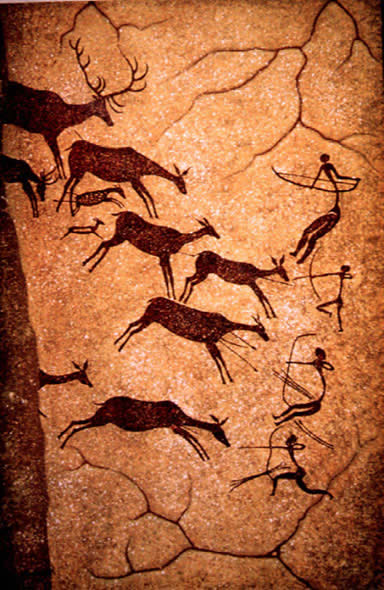
Geoglyphs are classified as rock art, which also includes pictographs and petroglyphs. Pictographs are rock paintings while petroglyphs are rock engravings. Pictographs are generally found in coastal mountain ranges while petroglyphs are more often found in the desert. Intaglios are often located near the Colorado River.

To understand the meaning of geoglyphs, an observer must be familiar with the complex and sophisticated symbolism of Native American culture. There are multiple interpretations of not only earth drawings but all rock art. It depends on who you consult. Native Americans have their own version, much of which is spiritually based. On the other hand, there are archeologists who prefer mythical interpretation. Religious scholars are able to see in geoglyphs ancient themes that appear not only in North American cultures, but in other cultures around the globe. But the bottom line is that all intaglios provide a unique window into Native American rituals, beliefs, and artistic abilities.

The Internet has been providing new glimpse and interpretation of rock art. With thousands of amateur and professional archaeologists sharing discoveries online, they’ve found some Native American rock-art symbolism that is identical to that found in other parts of the world. This means ancient people from other cultures must have migrated here thousands of years ago (or vice versa).

Most interesting are those experts who find geoglyph interpretation that parallels myth and legend found in all of humanity, suggesting that all cultures on earth had origin from a single, common influence. New sholars are pursing the study of sacred, ancient mysteries and the way these stories appear to be repeating themselves not only in other cultures but in our own time. The origin of Christianity, for example, contains ancient, hidden iconography, which some experts use to suggest that contemporay myths are really the same as those from bygone cultures and time.

Given the huge volume of rock art worldwide, one thing seems apparent: rock-art sites were as plentiful then as are churches today. Expression was important and widespread, the same as is religious worship today. And rock art expresssion must have been as sacred for them as religion is for people today.

The Blythe Intaglios

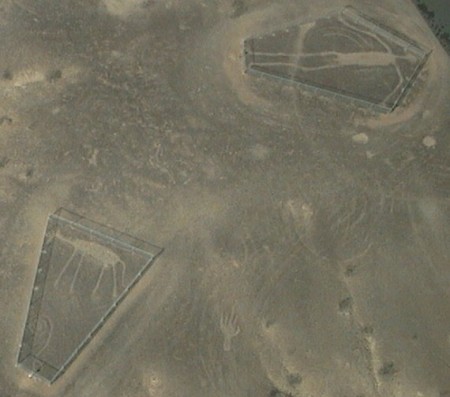
Ironically, the Blythe Intaglios site — discovered first — is now considered by experts to contain the most well known of all Southwestern desert drawings. They’re located approximately 15 miles north of Blythe, California, just west of the highway running along side the Colorado River. There are six distinct figures in three locations that are within approximately 1,000 feet of each other.


123


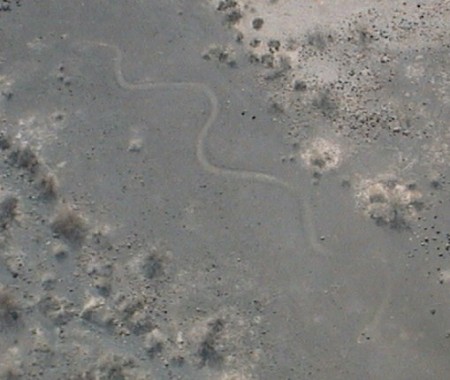
The Snake

Perhaps geoglyphs are just another variation on art form. Most intaglios are found near the Colorado River. Wherever man has found a plentiful and reliable food source, he has ended up with a surplus of time on his hands. Time translates into artistic expression. This is common occurrence throughout the history of civilization. British Columbian native inhabitants, for example, spent only a few minutes each day fishing the incredibly rich waters of the Northwest. The remainder time was used to create beautifully crafted totem poles.

45

Animals and the Gods of Ancient Egypt

Posted in Uncategorized on October 10, 2009 by dhenisee

Catmyw – Many deities were depicted as cats, both domestic or wild, and so they were seen as benevolent, sacred animals. Bast, originally a desert cat, was later depicted as a domestic cat. Ra was shown as ‘The Great Cat of Heliopolis’ who defeated Apep in ‘The Book of the Dead’.

Cattle (sığır) – mnmnt – Hathor, Isis, Nut and Bat were three goddesses who were often depicted as cows, with the horns of cows or with the ears of cows. Because of this, and because of the relationship of the pharaoh as a living god, the cow came to symbolize the mother of the pharaoh. The cow was also a solar icon, where Nut carried the sun across the sky on her back, when she was in cow form. The cow was linked to female fertility and to the mother of the pharaoh. Osiris was related to the bull – the Apis bull, after death, became Osiris-Apis. While it was still alive, the Apis bull was seen as the Ba of Ptah, mummified god of creation. The Mnevis bull was regarded as the Ba of Ra-Atum. The bull, therefor, was linked to masculinity and the pharaoh.

Crocodilemsh – Ammut, the demoness at the judgement hall, had the head of a crocodile along with other fearful creatures, and was known as ‘the devourer of the dead’ who punished evildoers by eating their hearts. The god of the Athribis region, the solar god Horus Khenty-Khenty, was sometimes shown as a crocodile. But the crocodile was also sacred to Sobek, who was portrayed as a human with the head of a crocodile, or as the crocodile itself. The temples of Sobek usually had sacred lakes where crocodiles were fed and cared for. The hippo goddess of childbirth, Taweret, was thought to have the back and tail of a crocodile, or was shown with a crocodile perched on her back.

Falcon / Hawkbyk – The sacred bird of the falcon-headed solar god Horus, it was also regarded as his Ba. The falcon was a bird that had protective powers, and was frequently linked with royalty, where it was depicted as hovering over the head of the pharaoh, with outstretched wings. The falcon was also sacred to Montu, god of war, and Sokar, god of the Memphite necropolis. The bird of prey was sometimes associated with Hathor, ‘The House of Horus’. The son of Horus, Qebehsenuef who guarded the canopic jar of the intestines, was a falcon-headed god. The human headed ba-bird was sometimes given the body of a falcon.

Heron (balıkçıl)bnw – The bnw-bird was represented as a heron, and was thought to be the original phoenix – it was a bird of the sun and rebirth, the sacred bird of Heliopolis, closely linked to the primeval mound. It was also thought to be the Ba of both Ra and Osiris.

Ibis (balıkçıl)hb – Regarded as the reincarnation of Thoth, the sacred ibis was sacred to the god of knowledge, who had the form of an ibis-headed man. The Akhu, part of the soul, was written with the sign of a crested ibis, known as the Akhu-bird.

Lionsmay – The lion was connected with the rising and the setting of the sun, and so were thought to be guardians of the horizon and were linked to solar deities. The earth god Aker was shown in the form of a ‘double sphinx’ – two lions seated back to back – and was thought to guard the sun as it entered and exited the underworld at the eastern and western horizons. Shu, god of dry air, and Tefnut, goddess of moist air, were lion-headed and lioness-headed deities respectively. Tefnut was given the title, the Eye of Ra. Many pharaohs associated themselves with lions, and so the lion came to symbolize rulership. Lions were also linked with ferocity and war-like deities. Sekhmet was either shown as a lioness, or a lioness-headed woman who came into being as the Eye of Ra to destroy mankind for Ra, who was also known for her healing powers. Hathor, goddess of love, was thought to have been sent out as the Eye of Ra, and so was also linked to lionesses. Even the cobra goddess, Wadjet, had a lioness form when she was identified as the Eye of Ra. Mut, too, had a lioness form when she was showing her more war-like side. The son of Bast or Sekhmet (there was confusion over the motherhood of this god in ancient times), Nefertem, was a lion-headed sun god of the lotus, healing and perfume. Another lion god was Apedemak who was known as ‘the splendid god at the head of Nubia, lion of the south, strong of arm’. Bes, dwarf god of sexuality and childbirth, was shown with either the ears and mane of a lion or as wearing a lion-skin cape.

Snakedjdft – The snake had mixed popularity in Egypt because snakes caused the danger and the cure to the venom. Apep was a snake-demon of the underworld, who tried to stop Ra on his nightly journey through the land of the west. The four primeval goddesses of the Ogdoad – Naunet (water), Amaunet (invisibility), Hauhet (infinity) and Kauket (darkness) – were also snake goddesses. There was a snake god called Nehebkaw who was depicted as a man with the head and tail of a snake.

Vulture (akbaba)nrt – sacred to Nekhbet, goddess of Upper Egypt and Mut, mother goddess. The vulture often holds the shn symbol of eternity in its talons, offering eternal protection to the pharaoh. As such, the vulture is closely linked to rulership.

Hieroglyph Converter

Posted in Uncategorized on October 10, 2009 by dhenisee

http://www.touregypt.net/ename/

Egyptian Hieroglyphs

Posted in Uncategorized on October 10, 2009 by dhenisee

Egyptians, when writing hieroglyphs, generally drew each hieroglyph in a square or rectangular area. Sometimes there might be one, two or more hieroglyphs in one area. The secondary hieroglyphs were usually smaller than the main one, though a number of small hieroglyphs could be used instead.

Direction of Writing: Hieroglyphs could be read in a number of directions, depending on how the hieroglyphs are set out. It is usually easy to tell – you read into the face of the hieroglyphic animals. For example, if the hieroglyph of the snake (or bird, etc) is facing to the right, you read the hieroglyphs from right to left… and vice versa. If there are two hieroglyphs in the same area, read the top-most one first, then the one under in the correct direction. This goes for hieroglyphs set out in rows or columns. Rows are, of course, read in the correct direction, and downwards… and columns are read across ways.

Phonograms: The Egyptians used a mixture of signs to get their meanings across in writing. They did not just use an alphabet, like we do, but they used signs that were combinations of sounds (such as the Japanese use ‘kanji’, the Chinese characters which usually have meanings that are words, as well as a specific Japanese alphabet.) Vowels were usually ignored, due to the fact that one hieroglyph may have different vowel sounds when used in combination with other letters. The singular form of a word might change vowel sounds when it becomes the plural.

The Alphabet:

a Glottal stop, like at the start of German words (a) Egyptian vulture
b Like a glottal stop, a consonantal y Flowering reed
 c y Two flowering reeds/oblique strokes
d  Guttural sound Forearm
1 w or u Quail chick
2 b Foot
3 p Stool
4 f Horned viper
5 m Owl
6 n Water
7 r Mouth
8 h as in ‘English’ Reed shelter in fields
9 Emphatic h Wick of twisted flax
10 kh as in Scottish ‘loch’ Placenta
11 ch as in German ‘ich’ Animal’s belly with teats
12 s/z Belt/folded cloth
13 sh Pool
14 Backward k, like q in ‘queen’ Hill slope
15 k Basket with handle
16 Hard g Stand for jar
17 t Loaf
18 Originally tsh (or tj) Tethering rope
19 d Hand
20 Originally dj and also a dull, emphatic s Snake

The Cave of Lascaux

Posted in Uncategorized on October 6, 2009 by dhenisee

caveOn Thursday, September 12, 1940…

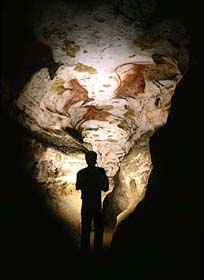
The calcite floor formed a succession of gours terraced basins, full of water. The uncertain light of their lamp barely pierced the darkness, and it wasn’t till they reached the first narrowing of the passage, at the entrance to a keyhole shaped gallery, The Painted Gallerya172_lascaux1,that the four teenagers made out the first paintings on the walls. Their names were; Marcel Ravidat, Jacques Marsal, Georges Agnel, Simon Coencas. A teenage jaunt on the hill overlooking the village of Montignac was to materialise into one of the most renowned archaeological discoveries of the 20th century.

In the middle of the woods, above the Lascaux manor, a hole had opened up following the fall of a big pine tree several years before. After enlarging the hole, they slipped through the narrow crevice then tumbled down a big pile of rocks which hid the original entrance of the cave. From the foot of this formation they ventured into a larger space which is now called the Great Hall of the Bulls. Large red cows, yellow horses, bulls and black stags, all in uncoordinated movement seemed as if they had been awakened from a night several millennia old by the expressions of joy evoked by this somewhat unreal discovery.

The whole cave was explored up to a narrower passage, which was difficult to pass through because, in addition to the narrowness, there was a shaft about 12 metres deep, which had to be descended by rope. Marcel Radiate ventured into the opening, widening it. When he reached the bottom he explored the only gallery in that network. On the way back he paid more attention to the walls and must have encountered the Bird-headed Man from the Scene of the Dead Man.

The news of the discovery spread like wildfire. On the following days the villagers came. Then came the leading lights of archeology at that time; Abbot Henri Breuil, Dr. Cheynier, Abbot J, Abbot A Bouysonnie and later D. Peyrony and Count Begouen.

Design a site like this with WordPress.com
Get started